
Lacey Directory Collections by Year
The Washington State Library city and telephone directory list is the controlling starting point. Its Olympia run begins with scattered nineteenth-century volumes, becomes more regular in the twentieth century, and continues through 2013. The catalog specifically identifies Lacey coverage within Olympia directories for 1974–82, 1984–97, and 2000–12. Those spans describe collection coverage, not a promise that each household appears in every volume.
| Directory collection | Years represented | Custodian | Access route |
|---|---|---|---|
| Olympia city and telephone directories | 1872–2013, with early gaps | Washington State Library | Cataloged; on-site |
| Olympia volumes listing Lacey | 1974–82, 1984–97, 2000–12 | Washington State Library | On-site by appointment |
| Thurston County directories | 1882–2005, in listed runs | Washington State Library | County collection |
| Olympia directory including Lacey and Tumwater | 1989 catalog item | State Library catalog | Library use only |
The county directory series is the best fallback when a city title is absent or an address fell beyond urban coverage. Its listed runs are scattered from 1882 through 2005. Compare the exact list before visiting. The State Library announced a closure effective July 1, 2025, with limited Thursday appointment access from 1 to 4 p.m.; confirm current access before travel.
A Lacey Directory Catalog Clue
The State Library catalog has a precise clue: “Olympia, Washington, city directory, including Lacey and Tumwater.” Metadata identifies a 1989 item and marks it LIB USE ONLY. That title matters. Searching only for a work beginning with “Lacey” can miss a volume whose geographic reach is wider than its main title.
The catalog record for the Olympia volume provides the source trail. The captured catalog view helps a researcher recognize the title and restriction before contacting staff.
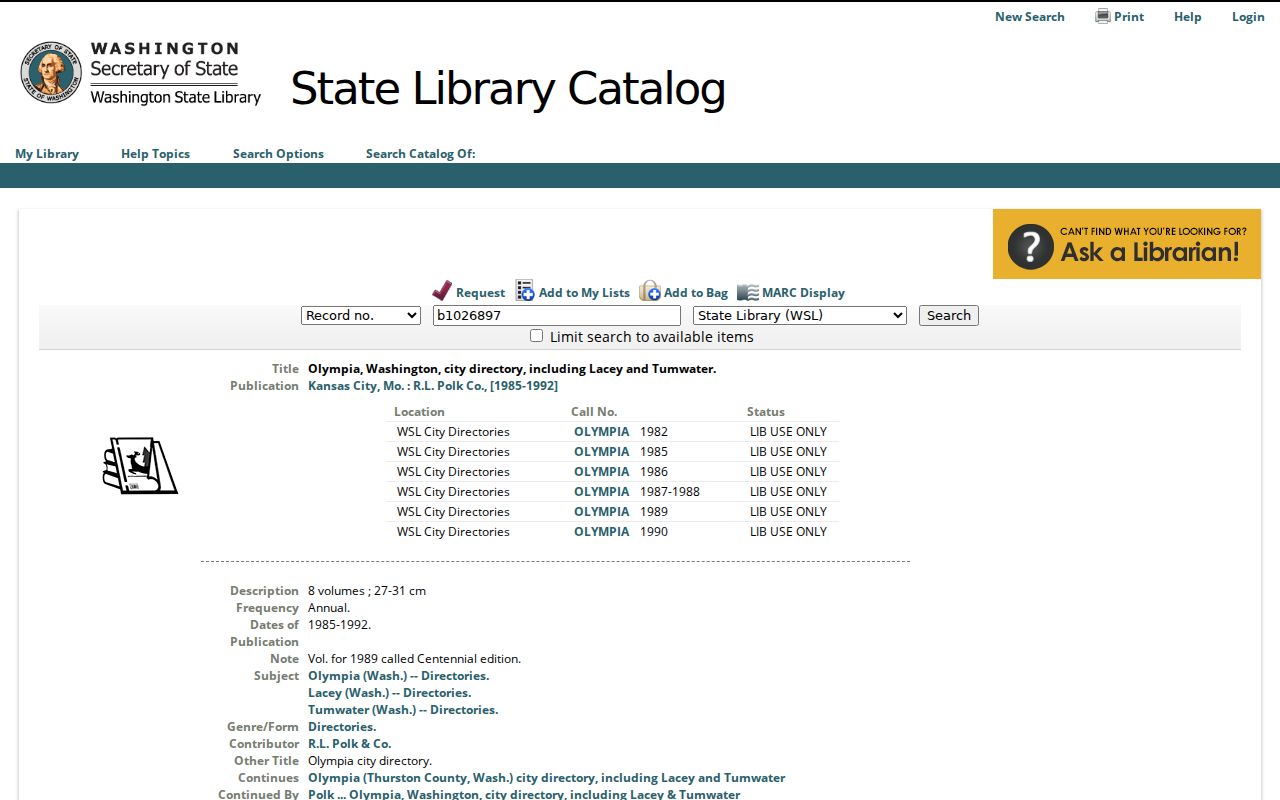
Give staff the catalog title, item year, and library-use note. They can confirm the volume, call information, and current handling rules. A catalog record proves that an item is described, but only the volume proves what appears on a page.
Reaching Lacey Genealogy Shelves
When a city directory is not remotely viewable, local access routes carry the search. Timberland Regional Library genealogy resources point to Ancestry Library Edition, HeritageQuest, newspapers, Northwest Digital Heritage, and regional partners. Lacey has been part of the Timberland system since 1968. Access can differ in a branch and at home, so ask which databases require an in-library session.
The genealogy landing page shown below leads into those tools rather than serving as a directory database itself.
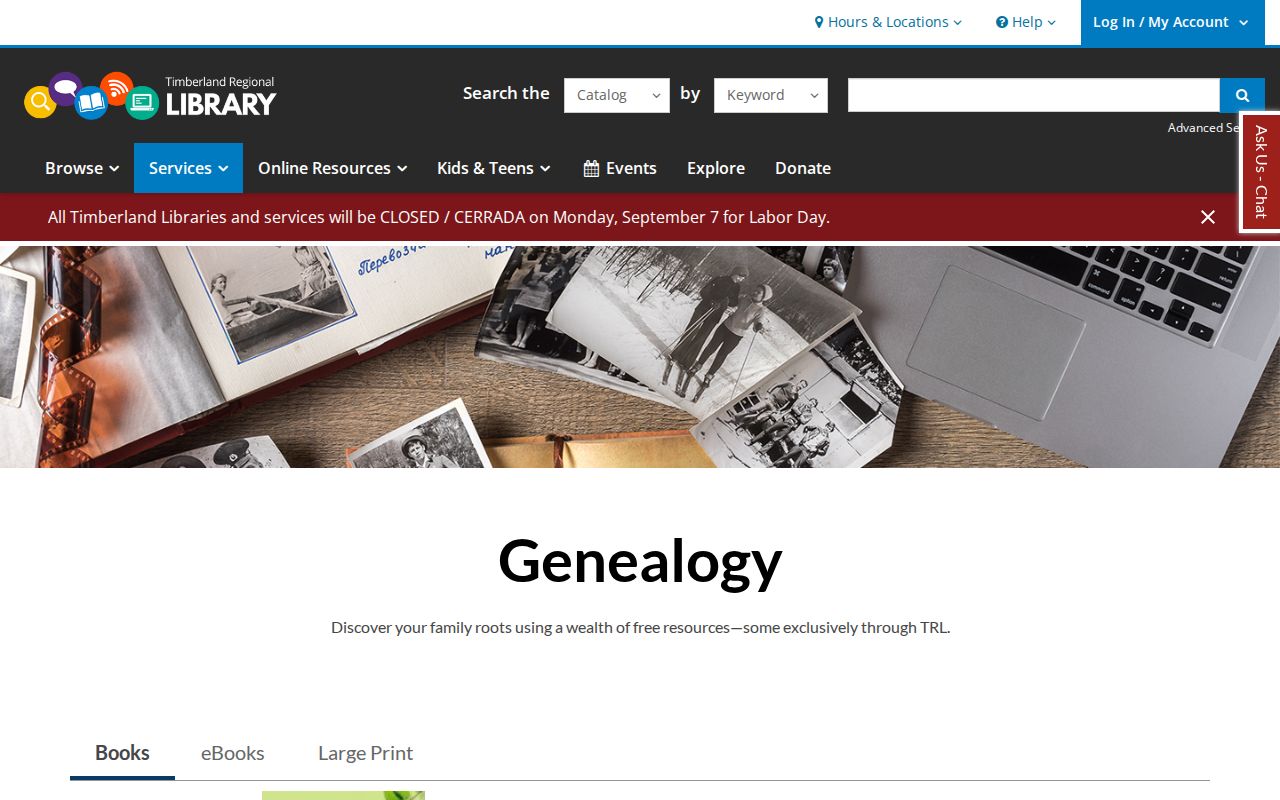
After a listing supplies a name and address, newspapers can add dated notices or business context. Save publication, date, and page because text recognition can misread surnames and street numbers. Staff and partner groups can locate a source, but a transcription should still be checked against the page image.
Reading Lacey Directory Entries
Start with the alphabetical name section, then inspect classified and business sections. Copy only what is printed. An entry may describe a phone subscriber, listed adult, business, or head of household. It is not a census and does not prove that all people at an address were recorded.
| Name as printed | Preserve initials, spelling, and stated relationships. |
|---|---|
| Address line | Record house number, street form, rural route, and place label. |
| Occupation or business | Treat it as a dated historical statement. |
| Page and volume | Keep both so the source can be found again. |
| Marks | Use that volume's own key before expanding them. |
Polk-style shorthand may include “h” for home, “res” for residence, “bds” for boards, “wid” for widow, and “av” for avenue. Those are likely forms, not universal rules. Photograph the key first.
- Criss-cross directory
- A later section arranged by street and house number rather than surname.
- Householder index
- An address list that may identify the person chosen as the primary listing.
- Abbreviation key
- The publisher's legend for shortened words, symbols, and relationship notes.
Lacey City Hall Genealogy Books
The Olympia Genealogical Society library adds another access channel. The society partnered with the City of Lacey, and its book collection is public at Lacey City Hall by appointment with Museum Curator Erin Quinn Valcho. Its catalog can be searched by title, author, publication, date, and tags. A tag may identify the City Hall box holding an item.
Search by surname and place, then try title or date. Send the curator the full description and box tag. The society can also be reached at info@olygensoc.org. The catalog is a collection finder, not a member list and not proof that a person appears in an item.
Lacey Directory Gaps at Museum
The Lacey Museum and Research Center can fill gaps left by print. The Museum is at 4160 6th Avenue SE, Suite 101, with free admission and listed hours Thursday and Friday 11 a.m. to 3 p.m. and Saturday 10 a.m. to 4 p.m. The Research Center at 829 Lacey Street SE is temporarily closed but may be available by appointment. Call 360-438-0209 before relying on access.
The physical index includes a 1978–79 business directory, 1920 census files for Chambers Prairie, Sherlock, and Woodland, a 1932 Nisqually/Lacey school census, school-register copies for 1909–11, 1913–17, and 1918–19, plus church, cemetery, community, and house files. These sources may preserve a name omitted from a city directory or listed under a rural community.
Note: An index entry means a file may exist; it does not mean that the file is digitized or open without staff help.
Old Names in Lacey Directories
Historic streets and moved buildings can defeat a literal search. The Groom-Turner House history says Margaret Street is now 6th Avenue. The Gallagher-Hukee House moved from the Pacific and Carpenter corner in 1985. The Huntamer House moved from 4624 Lacey Boulevard in 1997, and the Russell House moved in 1979. A missing modern map point is not proof that an old listing was wrong.
Search both street forms in directories, newspapers, deeds, and Museum files. The Lacey Historic Register supplies ownership and move histories. For present address records, the Lacey directory by street covers the county parcel and map route.
| Historic clue | Change | Next source |
|---|---|---|
| Margaret Street | Now 6th Avenue | Directory and register |
| Gallagher-Hukee House | Moved in 1985 | Museum file |
| Huntamer House | Moved in 1997 | Register and deeds |
| Russell House | Moved in 1979 | City and Museum files |
Trace Families Through Lacey Directories
A year-by-year method separates a plausible match from a documented trail. Start near a known event. Record variants instead of silently correcting them, then pair the listing with a source made for a different purpose.
- Choose the nearest volume and check name, business, and address sections.
- Copy title, year, page, name, place label, address, and marks.
- Move to prior and next years, noting gaps rather than assuming a continuous stay.
- Pair census years with deeds, newspapers, Museum files, and lawful vital-record routes.
- If a name vanishes, try a spouse, initials, alternate spelling, rural route, business listing, and county volumes.
For an 1850s ancestor, the Thurston First Record Book reaches deeds, probate, marriages, and commissioners' proceedings. Men may appear by surname and just two initials. Browse page ranges as well as searching a full name. Absence from a directory is never a negative identity finding.
Confirming a Lacey Directory Match
Save the volume title, year, page, exact text, repository, and access date. Include the abbreviation key when images are allowed. Nearby entries can show that the right street or locality is on the page, but they do not prove a private relationship.
Test the address against a dated deed, register entry, newspaper, school file, or census schedule. Modern GIS shows current status and should not be projected backward. When a historical find needs a present official check, use the Lacey resident lookup route and keep the records distinct.
Phone books and city directories also differ. A telephone volume may center on subscribers, while a city directory may add household, street, and business arrangements. County directories can reach rural routes that an Olympia title omitted. Record which type supplied the entry. If two volumes disagree, keep both dates and spellings, then compare them with the closest dated deed, newspaper notice, census schedule, or school file. A later source should not silently replace an earlier one.
Ask staff about copy and citation rules before a visit. Some material is available only on-site, some databases require in-library access, and the Museum Research Center may need an appointment. A precise request naming the title, year, surname, street, and likely page range gives the custodian a much better chance of finding the right Lacey entry.