
Lacey Previous Residents by Era
Choose a source by period and by the question it can answer. A recorded deed names parties to a land transfer. A directory or census may identify a household. A school or cemetery file can place a person in a local community, but may not prove the exact home. These Lacey sources overlap enough to test one against another. Previous residents become clearer when two dated layers agree.
| Historical source | Known span | Access point | Evidence it adds |
|---|---|---|---|
| Thurston County recorded land | 1979–2026 online archive series | Digital Archives; Auditor index and office | Parties, document type, addition, AFN and title events |
| Olympia directories including Lacey | Selected volumes, not a full Lacey run | Washington State Library and catalog | Dated names, addresses and household entries |
| Local census and school files | 1909–1932 named runs | Lacey Museum Research Center | Community, pupil and household evidence |
| First Record Book | 1852–1857 | Washington Digital Archives | Deeds, probate, marriages and early county proceedings |
| City clerk and public-works series | 1917–1993 series vary | State Archives lead; City request | Address, annexation, map and municipal-file context |
For a recent address, begin with the assessor and county recorder. For an early twentieth-century household, use directories beside census, school, and city files. The First Record Book reaches much earlier, when legal descriptions and names are more dependable search keys than a modern street number.
Walk Thurston Deeds Backward
A title chain follows recorded transfers from the current parcel toward earlier owners. Begin with Thurston County A+ Parcel Search and keep the parcel number, situs address, taxpayer name, and legal description. Next, search the Auditor’s Online Record Index by the current owner or parcel. The purchase deed identifies the seller, who then becomes the next name to search as a buyer in an older instrument.
- Find today’s parcel in A+ Parcel Search. Note the legal description as well as the street address.
- Locate the current purchase deed in the Thurston Online Record Index. Save its date, parties, document type, and AFN.
- Search the seller as a grantee to locate that party’s earlier purchase. Compare the legal description so a same-name result does not lead to another parcel.
- Repeat the buyer-to-seller switch for each link. Include assignments, releases, reconveyances, plats, and related records when they clarify the chain.
- When online images stop, inspect the full record at Recording Services, mail an AFN copy request, or contact the State Archives Southwest Region Branch.
- Grantor
- The party who transfers an interest in the recorded instrument.
- Grantee
- The party who receives that interest.
- Chain of title
- The linked sequence of recorded ownership transfers for one property.
- Legal description
- The formal land description, often based on a lot, plat, or boundaries, that can remain useful after an address changes.
Index information is a finding aid. Read the full instrument before treating it as proof of a transfer, and remember that a person in the title chain was not always a resident.
Lacey Previous Residents Since 1979
The Washington Digital Archives land series lists Thurston County recorded land from 1979 through 2026. Current-year transfers may be incomplete, and confidential data can limit an image. Search by party surname or company, first and middle name, Soundex, party type, addition-name keyword, and bounded years. Try both sides of the transaction and spelling variants.
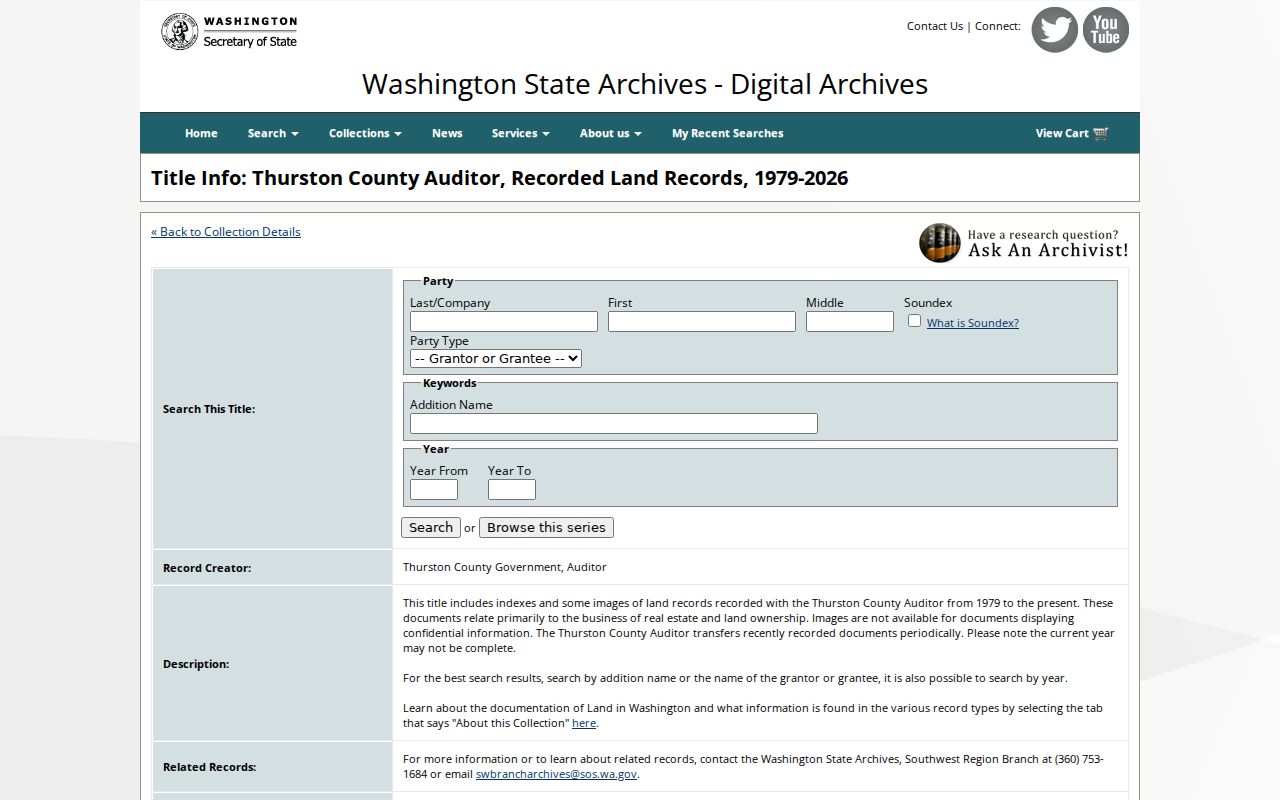
The addition and year fields help separate a Lacey parcel from same-name records elsewhere in Thurston County. Check the county index when the archive has not yet received a recent instrument.
The county office remains the complete access point. All records may be viewed there, although only selected deed, easement, lease, map, release, notice, and other classes have online images. Mail requests need the AFN, return address, and certification choice.
Pair Lacey Directories and Census
Ownership gives only half the address story. To test who lived there before, place each directory entry beside the closest available census or local enumeration. The Washington State Library identifies selected Olympia city and telephone directories that include Lacey and Tumwater. The run is not a complete independent Lacey series, so a missing name should trigger alternate searches, not a negative claim.
- Write down the directory year, printed street form, surname spelling, spouse or household notation, page, and volume title.
- Check an adjacent-year volume to see whether the household persists, arrives, or disappears between editions.
- Compare the closest census record by household, community, and neighbors. Preserve the enumeration area when it can be identified.
- Search rural-route forms, alternate surnames, a spouse, a business listing, and historic community names such as Woodland or Chambers Prairie.
- Use deeds, school files, or an obituary to test the date. Never turn one directory absence into proof that someone was gone.
The full volume runs and reading methods are covered with the Lacey city directory collections. Here, the entry serves one purpose: building a dated household layer around a known address.
Lacey House Files Name Owners
The Lacey Museum Physical Research Files Index names Bowker, Gallagher-Hukee, Groom-Turner, Jacob Smith, Huntamer, and Russell house files. Ask staff whether a file is available and what access rules apply. An index entry does not mean the contents are online. The Research Center at 829 Lacey Street SE is temporarily closed but may be available by appointment when staff can accommodate; the museum’s main number is 360-438-0209.
The Lacey Historic Register gives a strong preview of the place-based evidence.
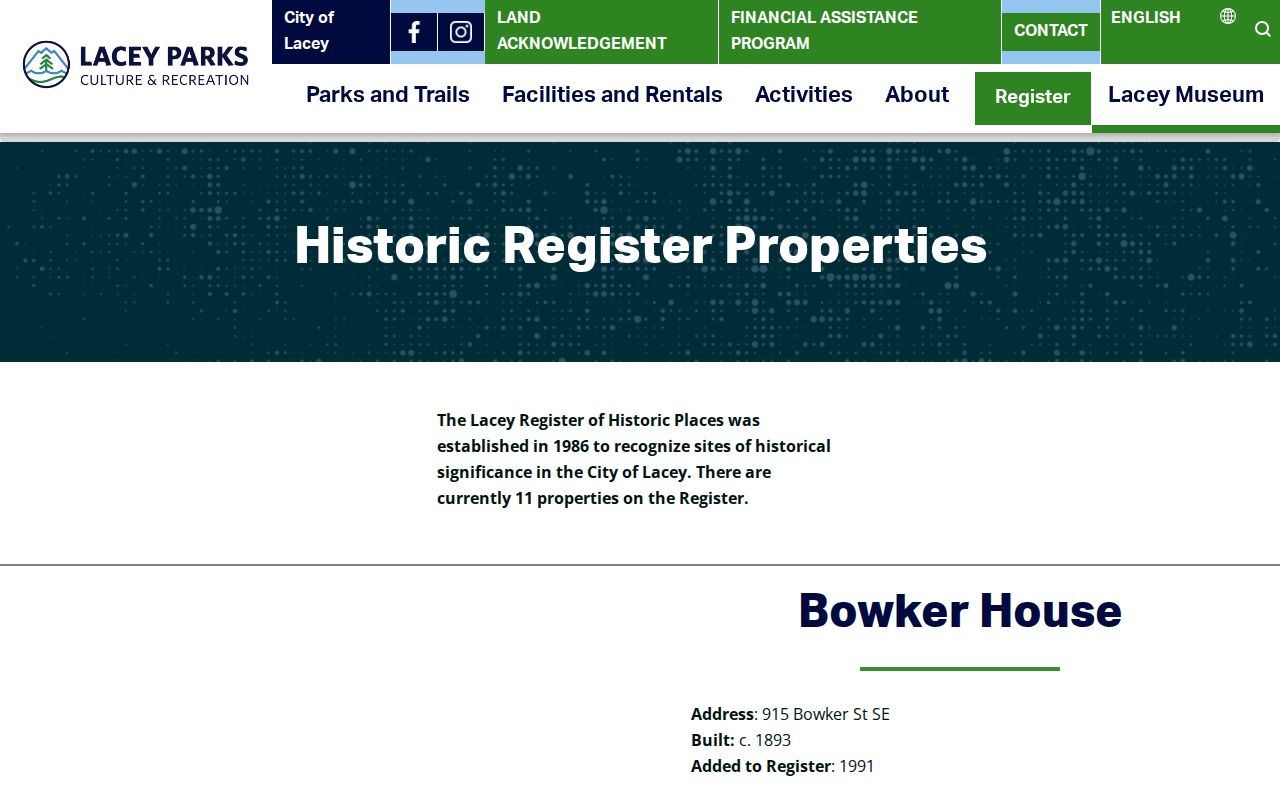
Register entries connect named former owners with specific buildings and moves. Confirm those narratives against the parcel and deed chain before extending them to a different lot.
When a Lacey House Moved
Several registered buildings no longer stand at the address tied to their early occupants. The Gallagher-Hukee House moved from the Pacific and Carpenter corner to the Museum in 1985. The Huntamer House moved from 4624 Lacey Boulevard in 1997. The Russell House, now at 829 Lacey St SE, moved in 1979 and had served as Lacey’s first city hall.
That history explains why a current GIS search can fail even when an old source is right. Search the building name, old address, new address, former owners, and move year. Then separate the history of the structure from the chain of the land it left behind. A previous resident may belong to the building’s old site, not the parcel where the building stands now.
Translate Old Lacey Addresses
The Groom-Turner history records that Margaret Street is now 6th Avenue. This is a verified example, not a complete renaming guide. Search both street forms in the recorder index, printed directories, newspaper OCR, museum folders, and public-works or annexation files. A legal description, plat name, addition, or parcel predecessor may bridge the change more reliably than the number alone.
City and urban-growth-area boundaries add another layer. A Lacey mailing label, ZIP area, historic community name, and legal city limit can point to different geographies. Use Thurston GIS for the current city-status field, but do not project a current map layer backward without a dated annexation or planning record.
Early Lacey Resident Records
The Thurston County First Record Book covers 1852 through 1857 and contains 529 pages of commissioners’ proceedings, deeds, probate, marriages, and other material. Its index is arranged around grantor and grantee names. The Archives warns that many men were entered with only their first two initials, and a multi-page name may be indexed only to the first page.
Browse the three page groups as well as the general index. Early land may use metes and bounds, a written course-and-distance description, rather than modern lot and block language. For later gaps, an archival abstract points to deeds from 1866–1919, tax-roll material from 1894–1965, voter books from 1909–1960, city clerk files from 1917–1985, and annexation maps from 1967–1978. Confirm the exact series and box with the Southwest Region Branch.
Lacey Household Clues Beyond Deeds
Museum files include 1920 census material for Chambers Prairie, Sherlock, and Woodland, plus the 1932 Nisqually/Lacey school census. School-register copies cover 1909–11, 1913–17, and 1918–19. The regional archive abstract also identifies Lacey School District records for 1913–18. These sources can place a family or child in a community when a city directory misses a rural route.
Church folders include Lacey Baptist, River Ridge Covenant, and Sacred Heart. Ruddell Pioneer Cemetery and St. Martin’s Cemetery also appear in local files, although no official searchable Lacey interment index was found. Ask institutions for public anniversary histories, programs, or registers. Do not assume a private membership list exists or should be disclosed.
Close a Lacey Household Trail
Obituaries, probate files, cemetery records, and newspapers can close the trail after previous residents leave an address. Washington Digital Newspapers should be searched by publication, date, page, and spelling variants, along with terms such as Lacey, Olympia, Tumwater, Hawks Prairie, Woodland, Chambers Prairie, Pacific Avenue, Carpenter Road, and a known house name. OCR can miss names, so inspect the original page image.
A probate filing can connect an estate to land, while an obituary may name relatives or a former community. Neither replaces a deed or a certified vital record. Ruddell Pioneer Cemetery has documented local history, including 1852 origins and a 1917 rededication, but a marker or transcription can contain errors. Cite the original register or custodian when possible.
Lawful use. Trace previous residents for house history, family research, or civic study. Do not use the trail to track, harass, or harm a living person.
The final claim should name its limit. A record may show an owner, listed householder, pupil, decedent, or party on a date. It does not identify every occupant, and it should not be used to publish a protected address.